45 machines · 14 grinders · makers' specs read 2026-11-09
The Best Espresso Machine for Your Budget, Drinks and Counter (2026)
By EspressoGoods editors · Updated 2026-11-09 · How we research · We may earn a commission from links.
Short answer
For most homes, start with the Breville Bambino Plus (around $500): a 3-second ThermoJet heat-up, PID and an automatic milk wand. Pair it with a grinder such as the Baratza Encore ESP. Want the grinder built in? The Breville Barista Express. Under $200: the De'Longhi Stilosa. Push-button lattes: the De'Longhi Magnifica Evo. Room and budget for two boilers: the Breville Dual Boiler.
Find the espresso machines that fit you
Answer what matters; leave the rest on “Any”. Matching uses only the makers' published specs and today's prices.
Wacaco Minipresso GR
Portable · No heater
Chefman CraftBrew Espresso Machine
Semi-automatic · 8.9 in wide
CASABREWS 3700 Essential
Semi-automatic · Flash heater · 51 mm
De'Longhi Stilosa
Semi-automatic · Single boiler · 8.07 in wide
CASABREWS CM5418
Semi-automatic · Flash heater · 51 mm
De'Longhi Classic (sold on Amazon as Classic Signature)
Semi-automatic · Flash heater · 9 in wide
Flair Classic
Manual lever · No heater · 40 mm · 6.25 in wide
CASABREWS 5418 PRO
Semi-automatic · Flash heater · 5.9 in wide
CASABREWS Ultra
Semi-automatic · Flash heater · 58 mm · 10.31 in wide
Breville Bambino
Semi-automatic · Flash heater · 54 mm · 7.7 in wide
CASABREWS Marenza
Semi-automatic · Flash heater · 58 mm · 8.9 in wide
Flair 49 PRO
Manual lever · No heater · 49 mm · 7.5 in wide

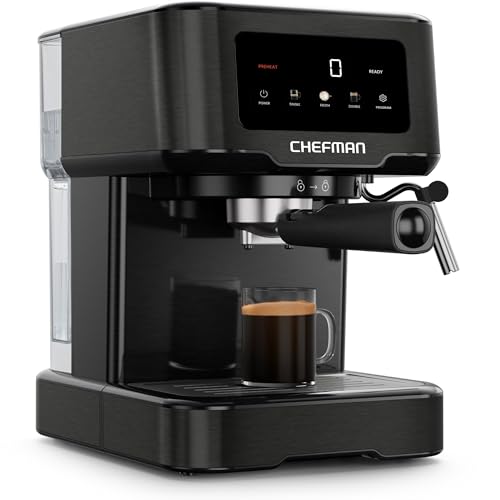

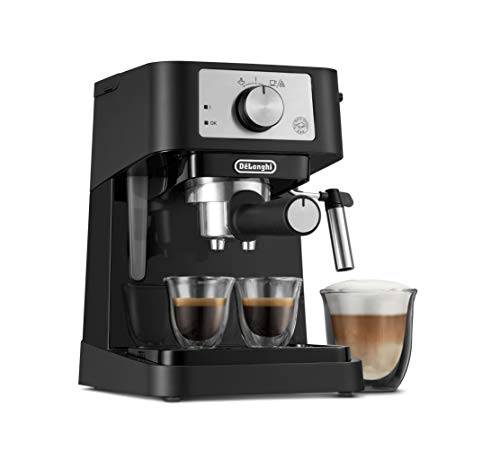


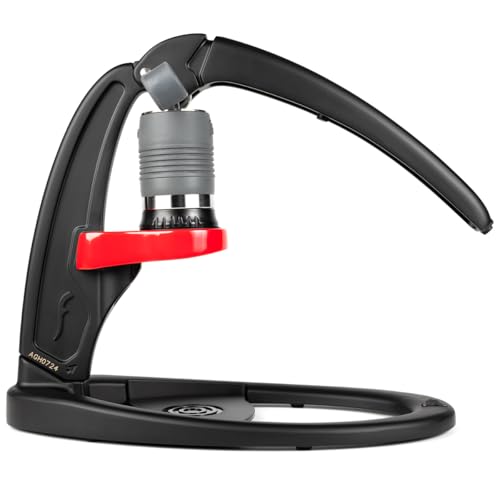


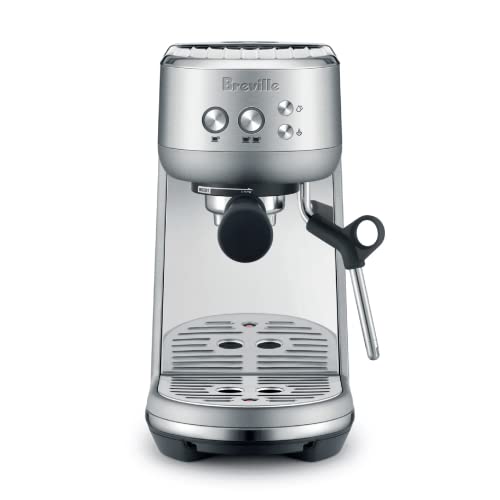


Showing the 12 lowest-priced matches. Narrow an answer, or open the compare tab to see all of them.
Specs are each maker's published figures (source linked per machine). Amazon prices as of 2026-11-13; prices change. We earn from qualifying purchases; it never affects matching or order, which is lowest price first.
The best espresso machine is the one that matches four facts about you: what you can spend once the grinder is counted, what you drink, how much work you want to do each morning, and how much counter (and cabinet clearance) you have. Get those right and most of the brand argument stops mattering.
This page compiles makers' published specifications for 45 home machines and 14 grinders, read on 2026-11-09, and turns them into a finder, a spec table and picks by need. We do not test machines, and nothing here describes using one. Where a maker does not publish a figure, such as PID on several De'Longhi models or warm-up time on most machines, we say so rather than guess. Prices on the cards update daily from Amazon.
If you only read one section, read the grinder one. A capable machine with pre-ground coffee or a blade grinder is the most common route to sour, thin shots, and it is why our picks list a grinder beside the machines.
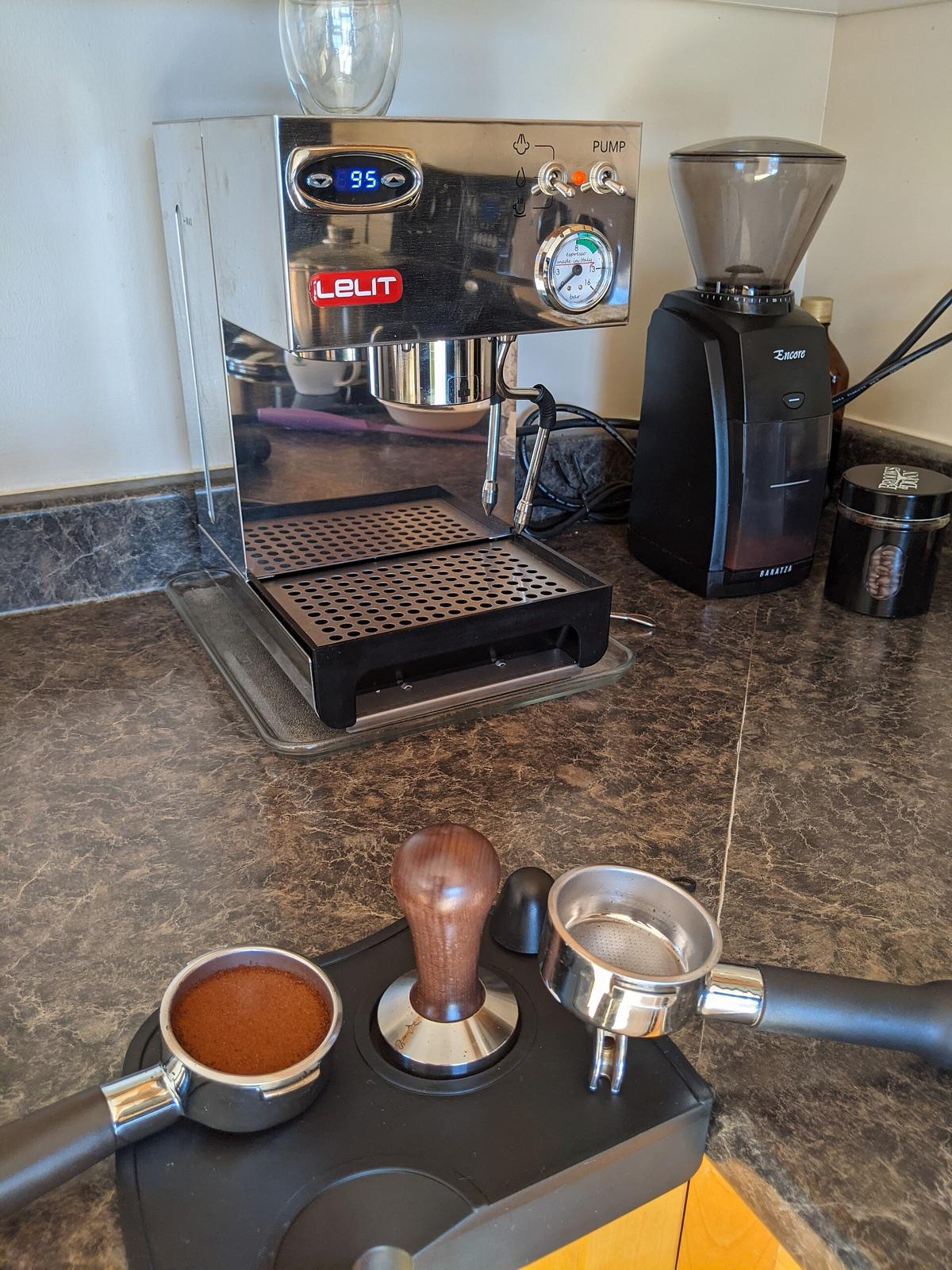
The best espresso machines by need
1. Best overall under $500
Breville Bambino Plus
Breville lists a ThermoJet heater that is ready in 3 seconds, PID temperature control, a 54 mm portafilter with single- and dual-wall baskets, and an automatic steam wand with adjustable milk temperature and texture. At 7.7 in wide and 12.2 in tall it fits where most machines in this price band do not.
Buy it if: Lattes and flat whites with little practice, on a small counter Skip it if: You want the grinder built in, or you plan to steam milk for several drinks back to back
- Type
- Semi-automatic
- Heating
- ThermoJet
- PID
- Yes
- Portafilter
- 54 mm
- Milk
- automatic steam wand (hands-free milk texturing)
- Heat-up (maker)
- ready to start in 3 seconds
- Water tank
- 64 fl.oz
- Size (W×D×H)
- 7.7 x 12.5 x 12.2 in (W x D x H, Breville listing on Amazon: 'a width of 7.7 inches')
- Weight
- 10.91 lb
Specs: Breville US product page (2026-11-09); Breville listing on Amazon (2026-11-09)
2. Best with a built-in grinder
Breville Barista Express
One box with an integrated conical burr grinder (16 settings), a Thermocoil heater with PID that Breville says delivers water at 200°F, a pressure gauge and a 67 oz tank. Breville's list price sits around $700; the card shows today's Amazon price, which was lower on our last read.
Buy it if: A first semi-automatic where you want grinding and brewing in one footprint Skip it if: Wall cabinets are low: Breville lists it at 15.9 in tall, against 12.2 in for the Bambino
- Type
- Semi-automatic
- Heating
- Thermocoil
- PID
- Yes
- Grinder
- integrated conical burr grinder, steel conical burrs, 16 precision grind settings
- Portafilter
- 54 mm
- Milk
- steam wand (manual milk texturing)
- Water tank
- 67 oz; bean hopper 1/2 lb
- Size (W×D×H)
- 15.9 x 13.1 x 12.4 in as printed on Breville's page; Breville's own Amazon listing gives a 15.9 in height, so the page's first figure is the height and its W×D labelling can't be relied on
- Weight
- 22.09 lb
Specs: Breville US product page (2026-11-09); Breville listing on Amazon (2026-11-09)
3. Best under $200
De'Longhi Stilosa
A stainless steel boiler, a 15-bar pump rating, a manual steam wand and two filters for single or double shots, in a body 8.07 in wide and 11.22 in tall. De'Longhi publishes no PID, warm-up or portafilter size for it, so expect less control than the picks above.
Buy it if: Trying espresso and milk drinks before spending more Skip it if: You want temperature control or plan to upgrade the grinder and dial in fine adjustments
- Type
- Semi-automatic
- Heating
- Boiler (stainless steel boiler)
- Milk
- manual steam wand
- Water tank
- 33.81 oz
- Size (W×D×H)
- 13.5 x 8.07 x 11.22 in (maker label: L x W x H)
- Weight
- 10.99 lb
Specs: De'Longhi US product page (2026-11-09); De'Longhi listing on Amazon (2026-11-09)
4. Best for lattes with automatic milk and a grinder
De'Longhi La Specialista Touch
De'Longhi lists an Advanced Thermoblock with PID, a conical burr grinder with 15 settings, two single-wall baskets and an automatic steam wand with 5 froth levels and 4 temperatures, plus 10 drink presets. At 15.87 in tall, measure under your cabinets first.
Buy it if: Milk drinks with a real portafilter workflow and less wand technique Skip it if: Your cabinets hang low over the counter
- Type
- Semi-automatic
- Heating
- Advanced Thermoblock
- PID
- Yes
- Grinder
- conical burr, 15 grind settings
- Milk
- automatic steam wand (5 froth levels, 4 temperatures, plus manual setting)
- Water tank
- 57.48 oz
- Size (W×D×H)
- 14.37 x 11.22 x 15.87 in (maker label: L x W x H)
- Weight
- 31.97 lb
Specs: De'Longhi US product page (2026-11-09); De'Longhi listing on Amazon (2026-11-09)
5. Best push-button super-automatic
De'Longhi Magnifica Evo (LatteCrema)
Beans in, drink out: a conical burr grinder with 13 settings, a Thermoblock, the LatteCrema milk carafe and 7 one-touch drinks including latte macchiato and iced coffee, with a 60.87 oz tank. There is no portafilter to tamp or dial in.
Buy it if: Households that want lattes at the press of a button Skip it if: You want to control grind, dose and shot time yourself
- Type
- Super-automatic (bean to cup)
- Heating
- Thermoblock
- Grinder
- conical burr, 13 grind settings
- Milk
- LatteCrema System (automatic milk frother, carafe)
- Water tank
- 60.87 oz
- Size (W×D×H)
- 9.4 x 17.3 x 14.2 in (maker label: L x W x H)
- Weight
- 26.28 lb
Specs: De'Longhi US product page (2026-11-09); De'Longhi listing on Amazon (2026-11-09)
6. Best dual boiler
Breville Dual Boiler
Separate brew and steam boilers with digital PID, a PID-controlled heated group head, a 58 mm portafilter and dual 15-bar pumps that Breville says allow milk texturing and extraction at the same time. An over-pressure valve limits maximum brew pressure. It is 15.9 in deep and weighs 28.35 lb.
Buy it if: Daily milk drinks for two or more, with full shot control Skip it if: You only drink straight espresso or your counter is shallow
- Type
- Semi-automatic
- Heating
- dual boiler
- PID
- Yes
- Portafilter
- 58 mm
- Milk
- steam wand (powerful manual milk texturing)
- Water tank
- 84 oz
- Size (W×D×H)
- 37.9 x 40.3 x 37.1 cm (W x D x H)
- Weight
- 28.35 lb
Specs: Breville US product page (2026-11-09); Breville listing on Amazon (2026-11-09)
7. Best for a small counter
Breville Bambino
The same ThermoJet heater, 3-second start, PID and 54 mm portafilter as the Bambino Plus in a 7.7 x 12.6 x 12.2 in body, with a manual steam wand and a 47 fl oz tank. It is the lower-cost way into Breville's small machines.
Buy it if: Straight espresso or hand-steamed milk where space is scarce Skip it if: You want the milk steamed for you
- Type
- Semi-automatic
- Heating
- ThermoJet
- PID
- Yes
- Portafilter
- 54 mm
- Milk
- steam wand (manual milk texturing)
- Heat-up (maker)
- ready to start in 3 seconds
- Water tank
- 47 fl.oz
- Size (W×D×H)
- 7.7 x 12.6 x 12.2 in (W x D x H, Breville listing on Amazon)
- Weight
- 10.42 lb
Specs: Breville US product page (2026-11-09); Breville listing on Amazon (2026-11-09)
8. Best manual (no electricity)
Flair 49 PRO
The Flair 49 PRO is a lever press with a 49 mm portafilter, pressurised and bottomless baskets, a built-in pressure gauge marked 6-9 bar and a 90 ml water capacity. You supply boiling water from a kettle and a grinder; there is no steam wand.
Buy it if: Straight espresso, travel or a kitchen with no spare outlet Skip it if: You drink milk drinks or make several shots in a row
- Type
- Manual lever
- Heating
- No heater (manual)
- Portafilter
- 49 mm
- Milk
- none
- Water tank
- Input Water Capacity – 90ml
- Size (W×D×H)
- 13.5" L x 7.5" W x 11" H (assembled)
- Weight
- 7 lb
Specs: Flair Espresso US product page (2026-11-09); Flair listing on Amazon (2026-11-09)
9. Best grinder to pair
Baratza Encore ESP
A 40 mm conical steel burr grinder whose settings 1-20 are micro-steps for espresso and 21-40 macro-steps for filter, per Baratza's listing. It stands 5.1 in wide, so it fits beside a Bambino, and it sits around $200.
Buy it if: Anyone buying a machine without a built-in grinder Skip it if: You already own a grinder that Baratza or its maker rates for espresso
- Burrs
- 40mm Conical Steel (M2)
- Espresso
- Maker sells it for espresso
- Settings
- 40
- Hopper
- 300g (10.6oz)
- Size (W×D×H)
- 13 x 15 x 34 cm (W x D x H)
- Weight
- 5.56 lb
Specs: Baratza US product page (2026-11-09); Baratza listing on Amazon (2026-11-09)




Product prices and availability are accurate as of 2026-11-13 and are subject to change. Amazon prices are for the colour linked. Specs are the makers' published figures; we don't test machines.
Four questions that pick the machine for you
Brand loyalty and pump numbers are poor starting points. These four answers narrow 45 machines to two or three, and they are the same four inputs the finder above asks for.
- What is the whole budget? Count the grinder. A machine without one needs an espresso-capable grinder, and in our catalogue those start around $70 (Shardor) and run to about $400 (DF64 II). Under $300 total usually means a pressurised-basket machine or a machine plus a modest grinder; around $700 buys either a built-in-grinder machine or a Bambino Plus with a good grinder; past $1,500 you are choosing between dual boilers and fully automatic milk systems.
- What do you drink? Straight espresso puts every dollar into the shot. Daily lattes make the steam system matter as much as the brew side, and automatic milk wands or carafes remove the hardest skill to learn. If two people want milk drinks every morning, steaming capacity becomes the deciding spec.
- How much do you want to do? A semi-automatic asks you to grind, dose, tamp and stop the shot. A super-automatic grinds, brews and often froths at a button press. A manual lever asks you to boil water and pull the shot by hand. None is better; they suit different mornings.
- Where will it live? Measure the counter depth, the width you can spare and the height from counter to the underside of your wall cabinets. A machine that does not fit under the cabinet gets pulled forward every day, and a deep machine on a shallow counter leaves no room for the cup.
The picks side by side
Every value below is the maker's published figure, copied from its product page or Amazon listing on 2026-11-09. Blank cells are blank because the maker does not publish that number. The full table of 45 machines, with each value linked to its source, is on the comparison page.
Read the table for gaps as much as for numbers. A maker that publishes its heater type, PID, portafilter size and warm-up time is giving you what you need to compare. Missing figures are common on super-automatics and on machines under $200, and a 54 mm or 58 mm portafilter matters if you later want better baskets or a bottomless portafilter, because accessories are sold by size.
| Machine | Type | Heating (maker's term) | PID | Built-in grinder | Portafilter | W x D x H (in) | Warm-up (maker) |
|---|---|---|---|---|---|---|---|
| Breville Bambino Plus | Semi-automatic | ThermoJet | Yes | No | 54 mm | 7.7 x 12.5 x 12.2 | 3 s |
| Breville Bambino | Semi-automatic | ThermoJet | Yes | No | 54 mm | 7.7 x 12.6 x 12.2 | 3 s |
| Breville Barista Express | Semi-automatic | Thermocoil | Yes | Yes, 16 settings | 54 mm | Height 15.9 (W and D not reliably published) | Not published |
| De'Longhi Stilosa | Semi-automatic | Stainless steel boiler | Not published | No | Not published | 8.07 x 13.5 x 11.22 | Not published |
| De'Longhi La Specialista Touch | Semi-automatic | Advanced Thermoblock | Yes | Yes, 15 settings | Not published | 11.22 x 14.37 x 15.87 | Not published |
| De'Longhi Magnifica Evo | Super-automatic | Thermoblock | Not published | Yes, 13 settings | None (no portafilter) | Height 14.2 (W and D unclear on maker label) | Not published |
| Breville Dual Boiler | Semi-automatic | Dual boiler | Yes | No | 58 mm | 14.9 x 15.9 x 14.6 | Not published |
| Flair 49 PRO | Manual lever | None (kettle water) | No heater | No | 49 mm | 7.5 x 13.5 x 11 | Kettle time |
Will it fit under your cabinets?
Height is the spec buyers forget. Wall cabinets hang over most kitchen counters, and a machine that stands taller than the gap has to be slid out for every shot or every refill. The published heights of our picks span almost five inches.
Two things add to the listed height. A bean hopper or a top-filled water tank needs room to open its lid, and a machine you fill from the top may need to come forward from the wall each time. Check the maker's manual for how the tank comes out before you buy for a tight spot. Depth matters too: the Breville Dual Boiler is 15.9 in deep before you add the portafilter handle sticking out at the front.
Thermoblock, single boiler, heat exchanger or dual boiler: what the heater changes
The heating system decides two things you notice every day: how long the machine takes to be ready, and whether you can steam milk right after brewing. Makers use their own names (Breville's ThermoJet and Thermocoil, De'Longhi's Advanced Thermoblock, Fellow's Boosted Boiler), but nearly all of them fall into four families.
A thermoblock heats water as it flows. Quick Mill, an Italian machine maker, describes it as "a compact heating element that heats water on demand as it flows through the machine", allowing "very fast heat-up times". That is why Breville can list a 3-second start for the Bambino. Breville also claims its ThermoJet is up to 44.3% more energy efficient than a thermoblock, a figure it attributes to its own internal benchmark testing.
A single boiler does both jobs in one tank. Profitec notes that you "switch the machine from brewing temperature to steaming temperature", which makes these machines "best suited for those who only prepare milk drinks occasionally". The Gaggia Classic, Rancilio Silvia and De'Longhi Stilosa in our catalogue are single-boiler machines.
A heat exchanger keeps one boiler hot enough to steam and runs brew water through a tube inside it, so you can brew and steam without waiting. La Marzocco's technical manager adds the catch: the brew water's temperature is "indirectly influenced by boiler pressure and requires a cooling flush to stabilize before each shot".
A dual boiler has two independent boilers, one for brewing and one for steam. Profitec says you can then "brew espresso and steam milk simultaneously". In our catalogue, five machines are dual boilers, from the Breville Dual Boiler to the Lelit Bianca. They cost more, weigh more and usually take longer to heat, but they remove the wait between shot and milk.
Is PID worth paying for?
PID stands for Proportional-Integral-Derivative, a controller that switches the heater on and off to hold a set temperature. Quick Mill puts it plainly: a PID "electronically regulates the heating element to minimise temperature swings", but "it is not the only way a machine can achieve stable brewing conditions". Machines without one use thermostats or other electronic controls.
In practice the label is now common at every price. Nineteen of the 45 machines in our catalogue list PID, including all five CASABREWS models under about $300 and seven of nine Breville models. Many super-automatics simply do not publish their temperature control at all, which is a gap in the spec sheet, not proof that they lack it.
Why the grinder matters more than most machine upgrades
Espresso is brewed from very fine coffee in about 25 seconds. INEI's certification guide calls for 25 seconds plus or minus 2.5. Breville's manual says the grind should be "fine but not too fine": too fine and water stalls and over-extracts into a bitter cup, too coarse and it runs fast and sour. Baratza advises going finer when a shot is sour and fast, and coarser when it is bitter and slow. You can only make those moves with a grinder that adjusts in small steps at the fine end.
This is where the basket matters. Breville's instruction books say single-wall baskets are for freshly ground whole beans, because they let you change the shot with grind, dose and tamp. Dual-wall (pressurised) baskets are for pre-ground coffee: they regulate pressure so the shot runs whatever the grind or freshness. Breville's Bambino and Barista Express ship with both.
So the real choice for a first machine is this. With pre-ground coffee, use the pressurised basket and accept a consistent but limited shot. With an espresso-capable grinder, switch to the single-wall basket and you can dial in. The Baratza Encore ESP, Breville Smart Grinder Pro, DF54 and Fellow Opus 2 are all in our catalogue with their makers' espresso claims.
Built-in or separate? A built-in grinder saves a second box and a second plug, and it is the simplest route for a first machine. A separate grinder usually gives finer steps and outlives the machine. Compare the numbers: the Barista Express grinder has 16 settings across its whole range, while the Baratza Encore ESP gives 20 micro-steps to espresso alone. If the machine fails or you upgrade, a separate grinder moves with you to the next one.
Why '15 bar' and '20 bar' don't mean better espresso
Box labels lead with pump pressure, and cheaper machines often print the biggest number. That figure is the pump's maximum rating. Espresso itself is extracted at about 9 bar: INEI's specification says "9 bar ± 1", and the heritage SCAA definition published by the SCA says 9 to 10 atmospheres. In the SCA's own barista survey, the average was 8.5 bar and the most common answer 9.
Breville's manuals show the same thing from the maker's side. The Barista Express book calls its rating "the 15 bar Italian pump", while the Dual Boiler book lists "pressure gauge not reaching 9 bars" as the fault to fix, and says an over-pressure valve limits maximum pressure. A 20-bar pump does not brew at 20 bar, and comparing machines on that number tells you almost nothing. Compare the heater, the temperature control, the basket and the grinder instead.
Super-automatic vs semi-automatic vs manual
This choice is about your mornings more than about the coffee. Each type has a clear trade.
- Semi-automatic (32 machines in our catalogue): you grind, dose, tamp and start and stop the shot, or let volumetric buttons stop it. Most control, most to learn, and the only type where a better grinder later makes a clear difference.
- Super-automatic (10 machines): the machine grinds, tamps internally, brews and, on models with a milk carafe or system, froths. The De'Longhi Magnifica Evo, Philips LatteGo models, Jura E-series and Ninja AutoBarista sit here. You trade fine control for speed and no mess on the counter.
- Manual lever (2 machines, both Flair): no pump and no heater; you pour in kettle water and press. The Flair 49 PRO has a gauge so you can see the pressure you apply.
- Portable (1 machine, the Wacaco Minipresso GR): hand-pumped, for travel and camping rather than a kitchen.
Common buying mistakes
Most regret with a first machine comes from one of a handful of choices made before it arrived.
- Spending the whole budget on the machine and nothing on the grinder.
- Choosing on the pump's bar rating rather than the heater, temperature control and baskets.
- Buying a single boiler for a home that drinks several milk drinks in a row, then waiting between each shot and steam.
- Forgetting cabinet height, or the extra room a top-filled tank or hopper lid needs.
- Expecting a super-automatic to behave like a semi-automatic, or the reverse.
- Using distilled or heavily filtered water. Breville advises against highly filtered, demineralised or distilled water, and ties descaling to the machine's own indicator and your water hardness rather than a fixed calendar.
How we pick, and what we don't do
We compile; we do not test. Every machine and grinder in the catalogue has a record built from its maker's product page, manual or official Amazon listing, with the read date. When makers disagree with their own listings, we note it and use the maker's figure. When a maker publishes nothing, the cell stays empty.
To decide which models enter the catalogue we look at which machines the ranking guides and owner forums keep naming, and at Amazon sales rank. Sales rank only helps us choose what to cover; we never display it, and we show no star ratings or review counts. Picks are then made on published specs against the four questions at the top of this page.
Prices change daily, so the cards and the finder show Amazon's price with the date it was read. Prose uses price bands. If a price on a card looks very different from the band we describe, the card is the current figure. We may earn a commission when you buy through those links; it does not change which machines appear or in what order.
Choosing the best espresso machine for you still needs one input we cannot read from a spec sheet: your own kitchen. Run the finder with your counter width and budget, then check the height chart above before you buy.
Every guide on EspressoGoods
Questions people ask
- What is the best espresso machine for home?
- For most homes, the Breville Bambino Plus: a 3-second ThermoJet start, PID, an automatic milk wand and a body 7.7 in wide. Add an espresso-capable grinder such as the Baratza Encore ESP. If you want one box with the grinder inside, the Breville Barista Express; if you want push-button lattes, a super-automatic such as the De'Longhi Magnifica Evo.
- Is a $100 espresso machine worth it?
- It can be, if you use the pressurised (dual-wall) basket with pre-ground coffee and accept limited control. Machines around $100 to $150, such as the De'Longhi Stilosa or CASABREWS models, make a concentrated coffee that works well in milk drinks. They are less suited to dialling in with a fine grinder, and makers at this price often omit specs such as warm-up time or portafilter size.
- Do I need a separate grinder for an espresso machine?
- Only if the machine has no grinder built in and you want to use single-wall baskets with fresh beans. Breville's manuals say single-wall baskets are for freshly ground whole beans and dual-wall baskets are for pre-ground coffee. The grinder must be one its maker rates for espresso; a filter-only grinder will not go fine enough.
- How many bars of pressure do I need for espresso?
- About 9 bar at the coffee. INEI specifies 9 bar plus or minus 1, and the heritage SCAA definition says 9 to 10 atmospheres. The 15-bar or 20-bar figure on a box is the pump's maximum rating, not the brewing pressure, so a higher number is not a reason to buy.
- What is the difference between the Breville Bambino and Bambino Plus?
- Both have the ThermoJet heater, a 3-second start, PID and a 54 mm portafilter. The Bambino Plus adds an automatic steam wand with adjustable milk temperature and texture and a larger tank (64 fl oz against 47 fl oz). The Bambino has a manual wand and costs less.
- Should I buy a super-automatic or a semi-automatic espresso machine?
- Buy a super-automatic if you want drinks at a button press with no grinding, tamping or counter mess. Buy a semi-automatic if you want to control grind, dose and shot time and are willing to learn. Super-automatics give up fine control; semi-automatics ask for a few minutes of work per drink.
- Does an espresso machine need PID?
- No. Quick Mill, an Italian maker, says PID helps hold a tight temperature but "is not the only way a machine can achieve stable brewing conditions". It is a useful feature, especially when you can set the temperature, but a machine without it is not ruled out.
- Can I make espresso with a moka pot instead?
- Not by the standard definitions. Bialetti says a moka pot brews at about 1.5 bar, while espresso machines work at about 9 bar or more. A moka pot makes strong stovetop coffee for far less money, but it is a different drink.
- What water should I use in an espresso machine?
- Breville advises against highly filtered, demineralised or distilled water. Use ordinary drinking water, set the machine's water-hardness option if it has one, and descale when its indicator says so rather than on a fixed schedule.
Sources & further reading
- Breville Bambino Plus BES500 product page (2026-11-09)
- Breville Bambino BES450 product page (2026-11-09)
- Breville Barista Express BES870 product page (2026-11-09)
- Breville Dual Boiler BES920 product page (2026-11-09)
- Breville Infuser BES840 product page (2026-11-09)
- De'Longhi Stilosa EC260BK product page (2026-11-09)
- De'Longhi La Specialista Touch EC9455M product page (2026-11-09)
- De'Longhi Magnifica Evo ECAM29084SB product page (2026-11-09)
- Flair 49 PRO product page (2026-11-09)
- Baratza Encore ESP product page (2026-11-09)
- Breville Barista Express BES875 instruction book (baskets, grind, 15 bar pump; 2026-11-09)
- Breville Bambino BES450 instruction book (basket use; 2026-11-09)
- Breville Dual Boiler BES920 instruction book (PID, 9 bar, OPV; 2026-11-09)
- INEI, A Brief Guide to the Italian Certified Espresso, p. 7 (Internet Archive copy, read 2026-11-09)
- SCA 25 Magazine, Defining the Ever-Changing Espresso (2026-11-09)
- Quick Mill, Guide to choosing an espresso machine (PID, thermoblock; 2026-11-09)
- Profitec, Which Profitec espresso machine suits you (boiler types; 2026-11-09)
- La Marzocco USA, The importance of dual boilers (2026-11-09)
- Baratza, Dialing in Espresso (2026-11-09)
- Bialetti, How the Moka works (2026-11-09)
EspressoGoods editors · Editorial team
EspressoGoods' catalogue and guides are compiled by the site's editorial team from espresso machine and grinder makers' own product pages, spec sheets and manuals, plus standards bodies such as the Istituto Nazionale Espresso Italiano. We do not test machines or taste shots, and we never claim to: every spec on the site links to the page it came from.
About this site · How pages are checked · Last updated November 9, 2026
As an Amazon Associate, EspressoGoods earns from qualifying purchases. It costs you nothing extra and never decides which machines we list.
EspressoGoods is an independent site. It is not affiliated with Breville, De'Longhi, Gaggia, Rancilio, Philips, Ninja or any other maker. Brand names and trademarks belong to their owners. Specs are the makers' published figures; check the maker's page before you buy.